The 5-Minute Rule for Projects That Actually Ship
Most technical projects die in the first hour — not because they’re too hard, but because they never get started. The 5-Minute Rule is a tiny constraint that forces you to start, move something into reality, and build momentum before perfectionism has time to wake up.
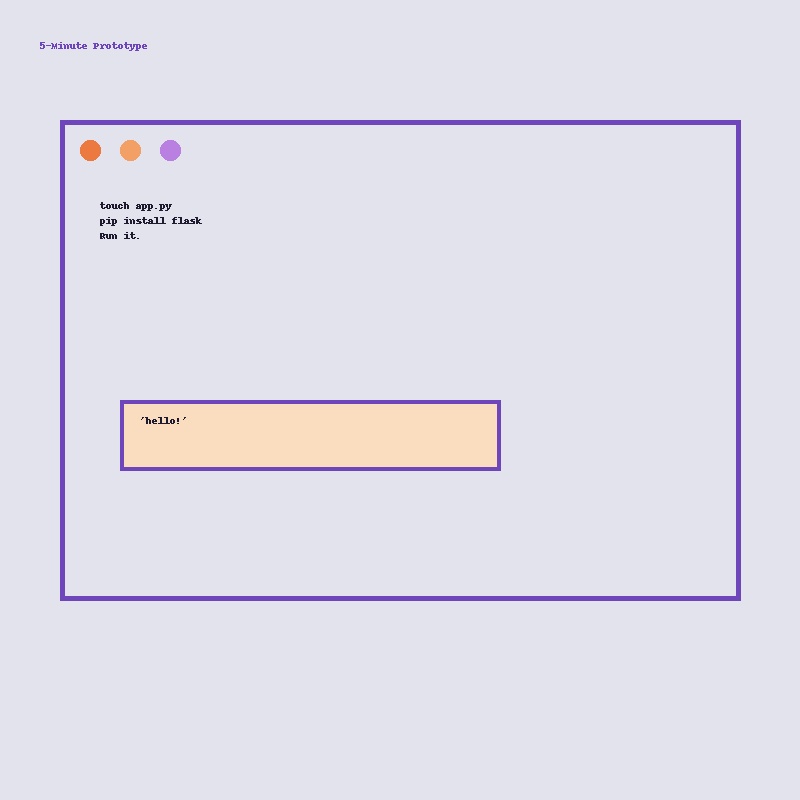
HELLO WORLD output you can actually run.
Before you start any new project, ask: “What is the smallest 5-minute version of this that produces a real, observable outcome?”
Not a perfect version. Not the final product. Just a 5-minute slice that creates visible progress — something you can run, click, or show to another human.
Why 5 minutes works
- Zero friction: 5 minutes is too small to fear, so you start instead of planning endlessly.
- Visible progress: You get a tiny win (a script that runs, a UI that loads) that unlocks motivation.
- Built-in scoping: You stop trying to architect the final system and focus on one end-to-end slice.
For most engineers, the real bottleneck is activation energy, not skill. The 5-Minute Rule pushes that energy barrier almost to zero.
Example 1 — A 5-minute web tool
Suppose you want to build a small web utility. The “proper” version might involve auth, a database, and a polished UI. The 5-minute version does one thing only: return a response in the browser.
-
Create a tiny Flask appMake a file and install Flask:BASH
touch app.py pip install flask -
Add a single routePut this in
app.py:PYTHONfrom flask import Flask app = Flask(__name__) @app.route("/") def index(): return "HELLO WORLD (5-minute prototype)" if __name__ == "__main__": app.run(debug=True) -
Run it and open the browserVisitBASH
python app.pyhttp://127.0.0.1:5000/and confirm you see yourHELLO WORLD.
You now have a working web app. It isn’t pretty, but it exists — and that’s the hardest part done.
Example 2 — A 5-minute data project
Instead of designing the “ideal” pipeline with orchestration, dashboards, and alerts, your 5-minute version just proves that you can read the data and see something on a screen.
import pandas as pd
import matplotlib.pyplot as plt

df = pd.read_csv("data.csv")
print(df.head())

df["some_column"].plot()
plt.show()
That’s it: you loaded the dataset, inspected it, and drew a first plot. Tomorrow’s job can be cleaning, modelling, or automation — but today, the project is officially alive.
Example 3 — A 5-minute hardware build
Hardware projects are especially vulnerable to “grand design syndrome”. A small 5-minute slice keeps things moving.
-
Connect and power the boardUnbox the board, plug in power and USB, and confirm the status LED or serial console looks healthy.
-
Flash a basic blink exampleLoad the simplest “blink” program available for your platform and deploy it. One LED toggling is enough.
-
Capture a quick demoTake a photo or a 10-second video of the LED blinking. You now have a physical artefact and a visible milestone.
Use this checklist whenever you feel stuck or overwhelmed by a new idea.
- Define one end-to-end action that fits comfortably into five minutes.
- Make sure it produces a visible result: output, UI, log line, or hardware effect.
- Do it immediately — no refactoring, no architecture diagrams, no backlog grooming.
- Capture the result (screenshot, commit, note) so you can see progress over time.
From tiny prototype to real project
The point of the 5-Minute Rule isn’t to stay in tiny prototypes forever. It’s to create a clean entry point into real work. Once a 5-minute slice exists, you can:
- Polish the UI or output while keeping the core behaviour stable.
- Wrap the prototype in tests and slowly harden it into production code.
- Decide, with evidence, whether the idea deserves more time at all.
The biggest blocker in engineering is often not knowledge, but inertia. Five minutes is enough to break that inertia and move from “I should build this someday” to “I shipped the first tiny version today.”
Related PLEX reading
References & further reading
-
Basecamp — Shape Up: Stop Running in Circles and Ship Work that Matters
A practical methodology for shaping work in small, well-defined bets instead of endless, undefined projects. -
Joel Spolsky — Fire and Motion
Classic essay on how small, consistent movement beats stalled “big bang” efforts in software projects. -
James Clear — Atomic Habits
Not a programming book, but an excellent explanation of why tiny, low-friction actions compound over time.