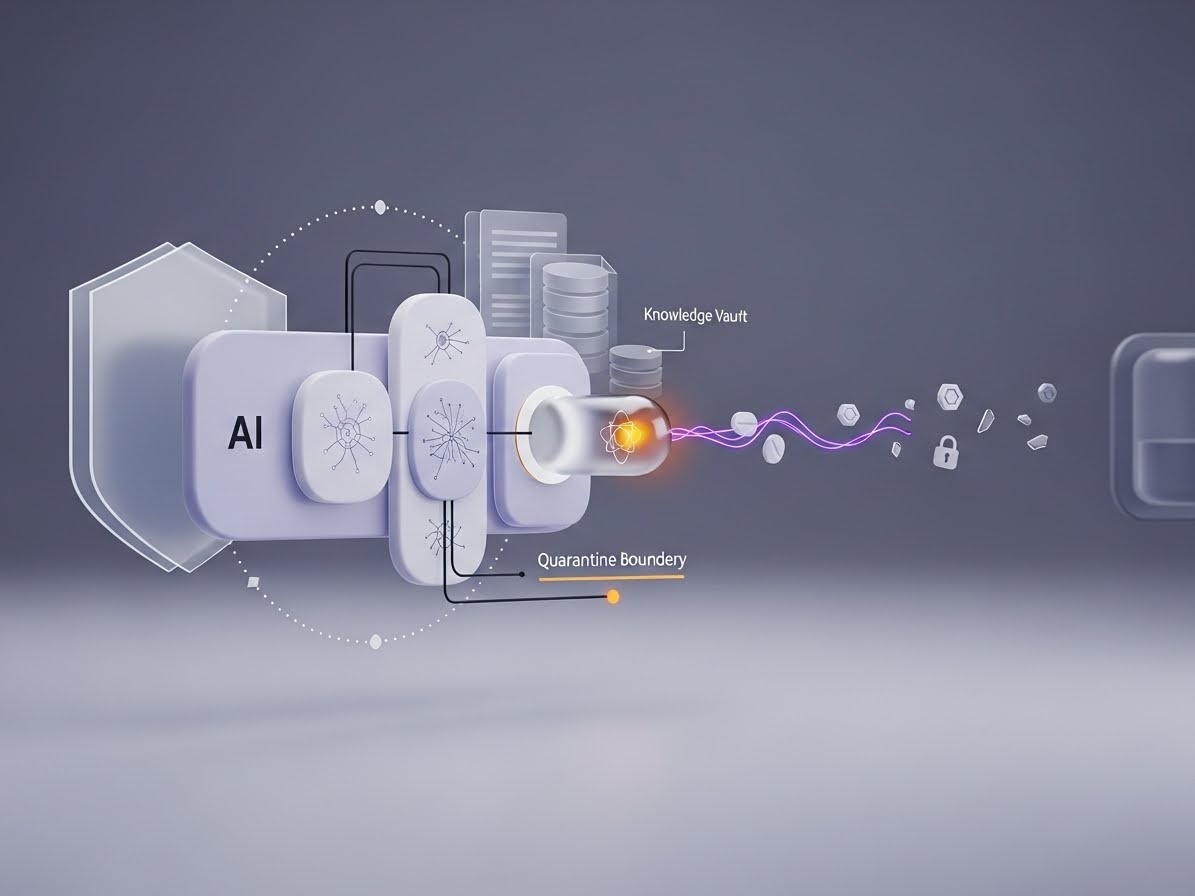
- Weaponized LLMs don’t “hack” you — they accelerate persuasion inside everyday tools.
- 2025 proved the pattern: prompt injection + deepfake impersonation + AI-scaled messaging.
- Best defense: reduce what AI can access/do, and verify high-impact actions (share/export/pay/reset).
POV: 2026 is the year “normal work” becomes the attack surface
I’m watching the same rollout happen in every office: AI assistants in email, AI summaries in meetings, AI copilots inside chat, AI “help” inside document systems. The pitch is always the same: faster work, fewer admin tasks, less friction.
Here’s the trade: attackers love friction too — because AI removes it. The most sophisticated breaches of 2026 won’t look like malware campaigns. They’ll look like a perfectly written message, delivered at the perfect time, followed by a normal action (share the file, export the list, approve the payment).
What 2025 already told us (and why it matters)
Start with the boring truth: breaches are still heavily human. Verizon’s 2025 DBIR executive summary puts the human element at roughly 60% of breaches and flags routine GenAI usage on corporate devices (Verizon 2025 DBIR Executive Summary). That’s the collision: human-driven incidents + widespread AI usage.
2025 in 60 seconds: the moments that shaped the 2026 playbook
Quick scan first. Details (and why they matter) right after.
What each event taught attackers (and what it teaches you)
1) Meta prompt/response exposure: “prompts are data now”
When Meta fixed a bug that could expose other users’ AI prompts and generated responses, it highlighted something many teams still treat as “low risk”: AI conversations are business records. They can contain client names, internal links, drafts, strategy, incident details — and sensitive text people would never put in a formal ticket. If prompt history leaks, you don’t just lose data — you lose context. (TechCrunch)
LLM trend: as AI becomes the default “thinking surface,” prompt retention, access control, and audit trails become security controls — not product features.
2) Italy’s voice-clone scam: familiarity is not authentication
The Reuters report on Italian police freezing nearly €1 million connected to an AI voice scam shows the practical threat: deepfakes succeed when process is optional. The call feels real, the story feels urgent, and a normal person follows a normal pattern: “help quickly, avoid embarrassment, don’t slow down the executive.” (Reuters)
LLM trend: LLMs write the pretext, stage the narrative, and produce perfect “supporting messages” in email/chat that make the call feel legitimate.
3) EchoLeak (CVE-2025-32711): prompt injection becomes enterprise-grade
CVE-2025-32711 is the cleanest “AI-native” lesson of 2025: if an assistant can retrieve internal knowledge, then the attacker’s game is to influence the assistant’s instructions. NVD describes an “AI command injection” issue that can enable unauthorized disclosure over a network (NVD).
LLM trend: “content-as-control” becomes a first-class risk. Your most dangerous input is the one that looks like a normal document.
4) 200+ AI content incidents: volume turns “maybe” into “eventually”
Microsoft’s reported 200+ AI-generated fake-content incidents (covered by AP) matters because it explains the modern success rate: attackers don’t need one perfect message. They need a pipeline that produces hundreds of good-enough attempts, learns what works, and targets the right people at the right time. (AP)
LLM trend: industrialized persuasion. The “breach” is often just the one time someone replies, clicks, shares, or approves.
What these events say about LLM-driven security trends
- Trust is moving from systems to language. When the message sounds internal, people treat it as internal.
- Prompt injection is the new “malicious attachment.” Content can steer assistants the way macros used to steer users.
- Tool-connected AI expands blast radius. If AI can search, share, export, or invite, attackers will aim at those boundaries.
- Attempts are cheap now. Volume + targeting turns security into a statistical game unless you add friction at key steps.
So what does a “data breach” look like in 2026?
Usually: a believable request + a boundary crossing. The boundary crossing might be a shared link, an exported list, a copied snippet, a reset, a payment approval, or an AI assistant retrieving something it shouldn’t.
The attacker’s advantage is not that the AI is smarter than you. It’s that the AI can try 100 variations, learn from failures, and keep the tone consistent — while you’re in meetings.
What you can do Monday morning
- Second-channel verification: any request that moves money, changes vendor details, resets access, or shares sensitive files.
- Stop “quick paste/export” behaviors: treat “just paste it here” the way you treat “just wire it now.”
- Reduce AI blast radius: least-privilege access to drives, CRMs, ticketing, chat. Default deny sensitive spaces.
- Lock down sharing: restrict external links and require approval for bulk exports.
- Use phishing-resistant MFA: don’t let “one successful login” become a full compromise.
We connected assistants to our tools because it makes work faster. That’s fine — but it changes the threat model. The win condition is simple: don’t let believable requests become irreversible actions. Build friction where it matters: sharing, exporting, paying, resetting, granting access.
Key learnings
- Weaponized LLMs = persuasion at scale + access to workflows and knowledge.
- Prompt injection matters when AI can retrieve sensitive data or trigger actions.
- Deepfakes break “familiar voice” trust — verify by process, not vibes.
- Volume wins: AI increases attempts, which increases the chance someone slips.