In 2026, the teams shipping ML safely aren’t “securing the model” as a single deliverable — they’re securing the path the model takes from raw data to runtime. That path is now a full supply chain: datasets can be poisoned, training environments can leak, artifacts can be swapped, evals can be gamed, and LLM/RAG systems can be steered into unsafe behavior with surprisingly normal-looking inputs. The fix isn’t heavier process. It’s a fortified stack: lightweight controls at each layer so one weak link can’t quietly compromise everything downstream.
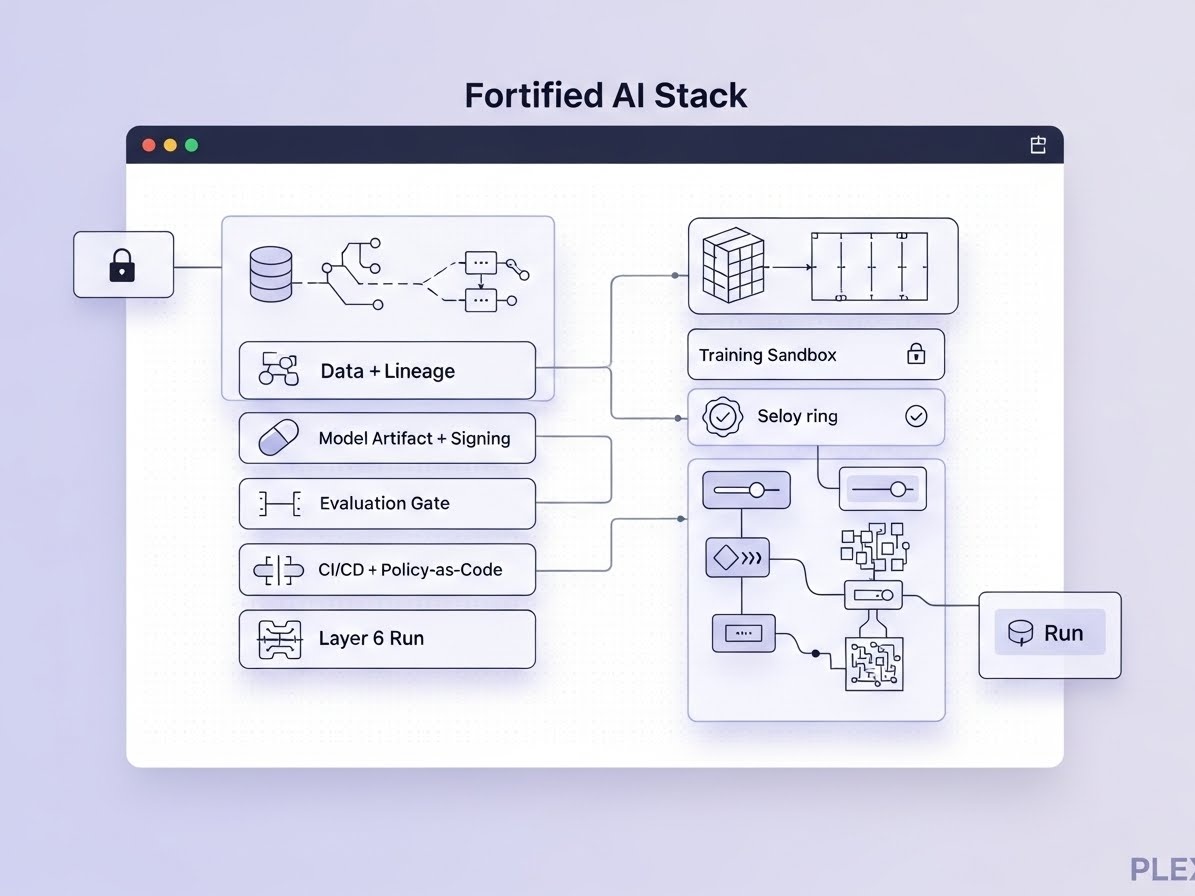
“Secure the model” is the wrong target. Teams are locking down the workflow: data → training → artifacts → evaluation gates → policy-driven deploy → runtime monitoring → incident response. The winning pattern: treat ML like a software supply chain plus a production service.
- Make inputs verifiable: governed access, snapshots, lineage, ingestion validation.
- Make builds provable: hardened jobs, reproducible envs, signed artifacts + attestations.
- Make runtime containable: least-privilege, monitoring for drift/abuse/leakage, fast rollback/kill switch.
The shift: the attack surface is the workflow
Security used to focus on “the endpoint” — the API, the cloud account, the perimeter. ML broke that model. An attacker doesn’t need to break into prod if they can influence what becomes prod: a dataset, a dependency, a registry artifact, a retrieval index, or a prompt pathway that leaks sensitive data into logs.
So teams adapted. They stopped treating security as a post-launch audit and started building a system where every stage is bounded, traceable, and easy to roll back.
The Fortified AI Stack: six layers that actually matter
1) Data governance, validation, and lineage
High-leverage security starts before training: restrict raw access (separate “explore” vs “train”), snapshot datasets immutably, and fail ingestion on obvious anomalies (schema breaks, spikes, duplication, label-rate shifts). Lineage isn’t paperwork — it’s how you answer “what exactly trained this?” when something goes wrong.
2) Hardened training environments
Training jobs are high-privilege batch workloads. Mature teams treat them like production services: ephemeral workers, controlled egress (allowlist what they can reach), pinned dependencies, and short-lived credentials (OIDC/workload identity where possible). If a notebook can print it, a model can leak it — so secrets stay out of notebooks and environment dumps.
3) Signed artifacts + provenance you can verify
Models are now shipped like binaries: built in a controlled pipeline, stored in a registry, and verified before deploy. The artifact isn’t “trusted” because it exists — it’s trusted because it’s signed and paired with attestations (data snapshot hash, code revision, config, base image digest, eval summary).
4) Evaluation gates (including adversarial tests)
In 2026, evaluation is not a one-off report — it’s a gate. Standard regression checks cover quality, latency, stability, and cost budgets. For LLM/RAG, teams add threat-driven suites: prompt injection attempts, tool misuse, retrieval poisoning, and sensitive-data extraction patterns. The key is consistency: every release runs the same “ship/no-ship” tests.
5) Policy-as-code in CI/CD
This is how you keep velocity. Instead of meetings, policy runs at merge/build/deploy time: block unsigned artifacts, reject missing provenance, enforce approved base images, and require isolation/egress rules for training jobs. The best workflows automate the boring “no” decisions so humans only handle exceptions.
6) Runtime containment: least privilege + monitoring + rollback
Runtime is where attackers interact. Lock it down like any production system: segment networks, scope IAM/tool access tightly (especially for agentic systems), and monitor beyond uptime — drift, abuse patterns, and data leakage signals. Most importantly: design for controlled failure modes (canary releases, automated rollback, tool/retrieval circuit breakers, and a kill switch).
The 80/20 fortified stack (what teams implement first)
- Immutable dataset snapshots + basic ingestion validation that can fail closed.
- Ephemeral training jobs with restricted egress and short-lived identity.
- Signed model artifacts with minimal attestations (data hash + code SHA + config + eval result).
- One required eval gate that blocks promotion on regressions (and adds LLM threat tests where relevant).
- Policy-as-code deploy rules (unsigned / missing provenance = no ship).
- Runtime rollback + kill switch, plus monitoring for drift/abuse/leakage.
Incident response for ML (the part most teams forget)
ML incidents aren’t just “the service is down.” They can be a compromised dataset snapshot, a poisoned retrieval index, an unsigned artifact in the registry, or sensitive prompt logs. The best teams predefine containment actions so response is fast and boring.
- Evidence capture: artifact digests, attestations, request traces, retrieval hits.
- Containment switches: freeze promotions, revoke credentials, disable tools/retrieval, roll back.
- Ownership: who contains, who remediates, who signs off on re-enable.
If you take one thing from this: don’t aim for “perfectly secure ML.” Aim for a workflow that is verifiable and recoverable. That’s what lets teams ship quickly without turning every release into a risk bet.
Related PLEX reading
References & further reading
- NIST AI Risk Management Framework (AI RMF 1.0)
- OpenSSF SLSA (Supply-chain Levels for Software Artifacts)
- Sigstore documentation (signing & verification for artifacts)
- in-toto (supply-chain provenance & attestations)
- OWASP Top 10 for Large Language Model Applications
- MITRE ATLAS (Adversarial Threat Landscape for AI Systems)